INVASIVE PUBLICS_Gabrielle Selvaggio and Yuyi Shen
True public spaces should be active, radical, and overflowing with character. Today, San Francisco’s urban fabric containing its financial district lacks identity and hinders social interaction. Predominantly gentrified by white and wealthy populations of the Dot Com Boom, mainstream, commercial and technological interests influence the entire city of San Francisco.
Before the virtual wave, SOMA district symbolized middle class immigrants, who relied on human relations and worked in factories and sweatshops. In the 1960s, hippie and free love movements fostered vibrant new attitudes of communal living, androgynous fashion, gay pride, and activism in the streets. Progressively, in the 80s and 90s, local establishments became hubs for art, music, and performative culture, later subverted into other districts.
From this research, a place is defined by its cultural identity, supported by its local community’s historical background, diverse forms of communication, and livelihoods of its people. Understanding this, how can a counter fabric invade existing urban spaces to foster new kinds of social relationships? How can these new social relationships drive people away from spectacle culture?
In response to these questions, we are basing our degree project in 3 locations, the corporate hub in SOMA’s Transbay Temporary Terminal, and San Francisco’s more recognizable cultural hubs in Garfield Square and Castro. We seek to connect occupants of different districts within the city through an interactive network of playscapes. These will extract physical information and actions from one place and translate them into multiple perceptions of the body in another through material landscape, sensory atmosphere, and virtual technology. We aim to stimulate non-hierarchical creative processes and collaboration between players to establish a new urban consciousness that allows leeways for interpretation, improvisation, and rebellious behavior.
Before the virtual wave, SOMA district symbolized middle class immigrants, who relied on human relations and worked in factories and sweatshops. In the 1960s, hippie and free love movements fostered vibrant new attitudes of communal living, androgynous fashion, gay pride, and activism in the streets. Progressively, in the 80s and 90s, local establishments became hubs for art, music, and performative culture, later subverted into other districts.
From this research, a place is defined by its cultural identity, supported by its local community’s historical background, diverse forms of communication, and livelihoods of its people. Understanding this, how can a counter fabric invade existing urban spaces to foster new kinds of social relationships? How can these new social relationships drive people away from spectacle culture?
In response to these questions, we are basing our degree project in 3 locations, the corporate hub in SOMA’s Transbay Temporary Terminal, and San Francisco’s more recognizable cultural hubs in Garfield Square and Castro. We seek to connect occupants of different districts within the city through an interactive network of playscapes. These will extract physical information and actions from one place and translate them into multiple perceptions of the body in another through material landscape, sensory atmosphere, and virtual technology. We aim to stimulate non-hierarchical creative processes and collaboration between players to establish a new urban consciousness that allows leeways for interpretation, improvisation, and rebellious behavior.
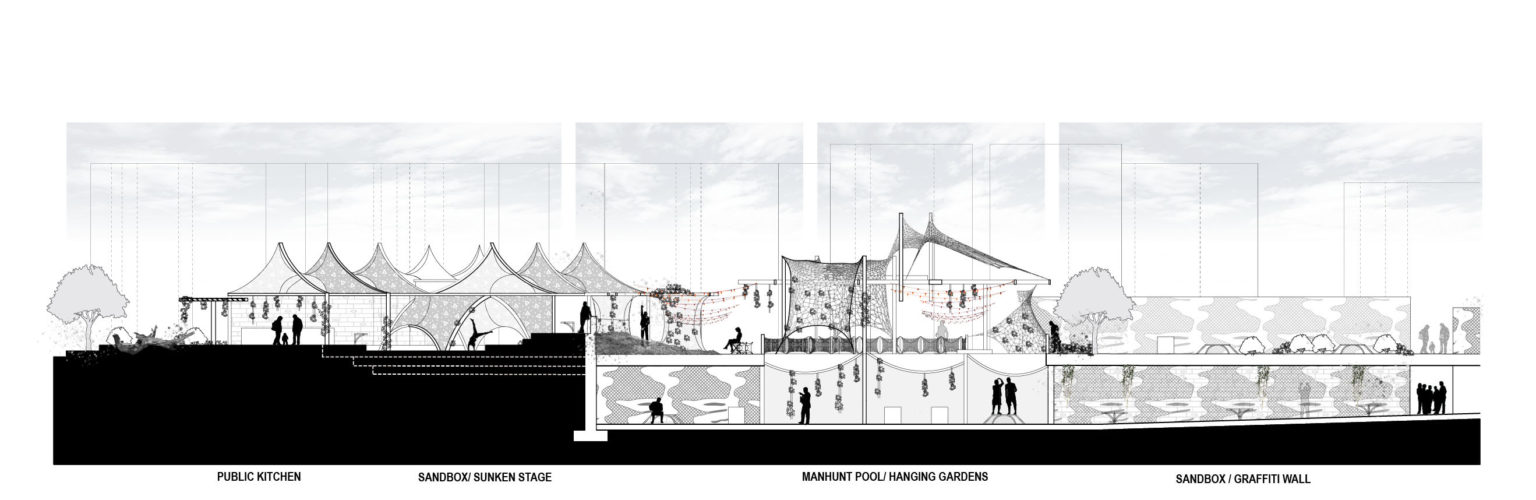
Site 1: Transbay Plan
Site 1: Transbay Activity
Site 2: Garfield Square Activity
Site 3: Castro Activity
Invasive Publics Presentation Walkthrough
DP Presentation_ Invasive Publics
DP Booklet_Invasive Publics